
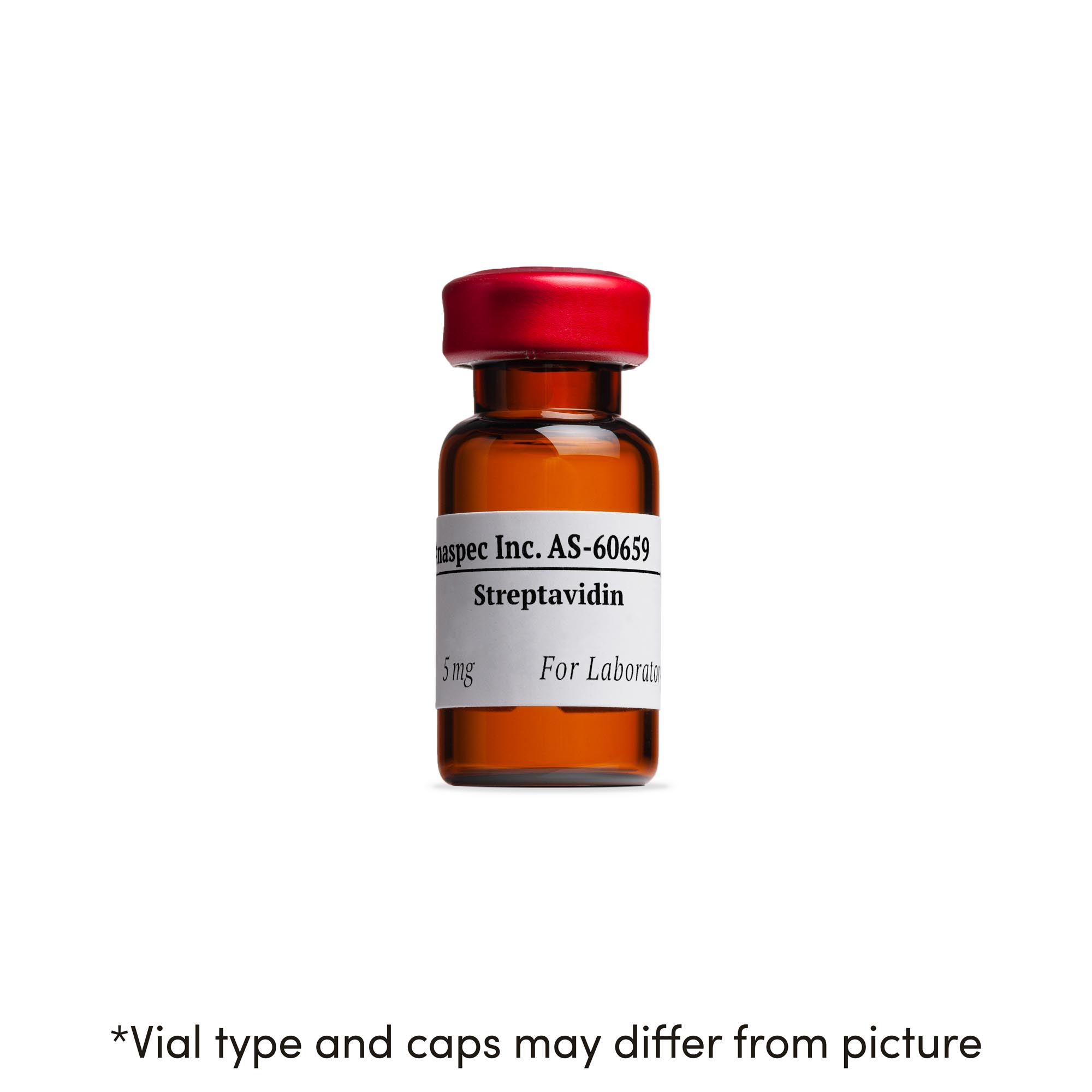
Streptavidin
Price range: $193.00 through $1,540.00
Streptavidin, used in applications: immunoassays, histochemistry, FISH (Fluorescence In Situ Hybridization), flow cytometry, microarrays, blot analysis.
Overview
Streptavidin is a highly regarded protein used in various biotechnical applications, including immunoassays, histochemistry, FISH (Fluorescence In Situ Hybridization), flow cytometry, microarrays, and blot analysis. Its unique ability to bind biotin with remarkable strength (Kd ~10-15 M) makes it an invaluable tool in research and diagnostic settings.
Key Features
- High-affinity binding to biotin
- Non-glycosylated, tetrameric structure
- Low nonspecific binding compared to avidin
- Ideal for various assay techniques
- Compatible with multiple labeling applications
Specifications
| Property | Details |
|---|---|
| Protein Type | Nonglycosylated |
| Binding Strength | Kd ~10-15 M |
| pI | Near-neutral |
| Usage | Immunoassays, histochemistry, FISH, flow cytometry, microarrays |
FAQ
What is the advantage of using streptavidin over avidin?
Streptavidin offers significantly lower nonspecific binding than avidin, making it a better choice for sensitive applications.
Can I use streptavidin in my flow cytometry experiments?
Yes, streptavidin is excellent for flow cytometry and enhances the specificity and sensitivity of your assays.
Where can I find biotin for my experiments?
You can purchase high-quality biotin through our selection of products, including Biotin (d-Biotin) and Biocytin [Epsilon-Biotinoyl-L-Lysine].
Ready to enhance your research with high-quality streptavidin? Browse our range of non-fluorescent options today and discover its versatility in various applications, or check out our recombinant streptavidin for even more possibilities.
Browse more in Non-fluorescent.
| Size | 100 mg, 5 mg |
|---|
Be the first to review “Streptavidin”
Related products
Non-fluorescent
Reviews
There are no reviews yet.