
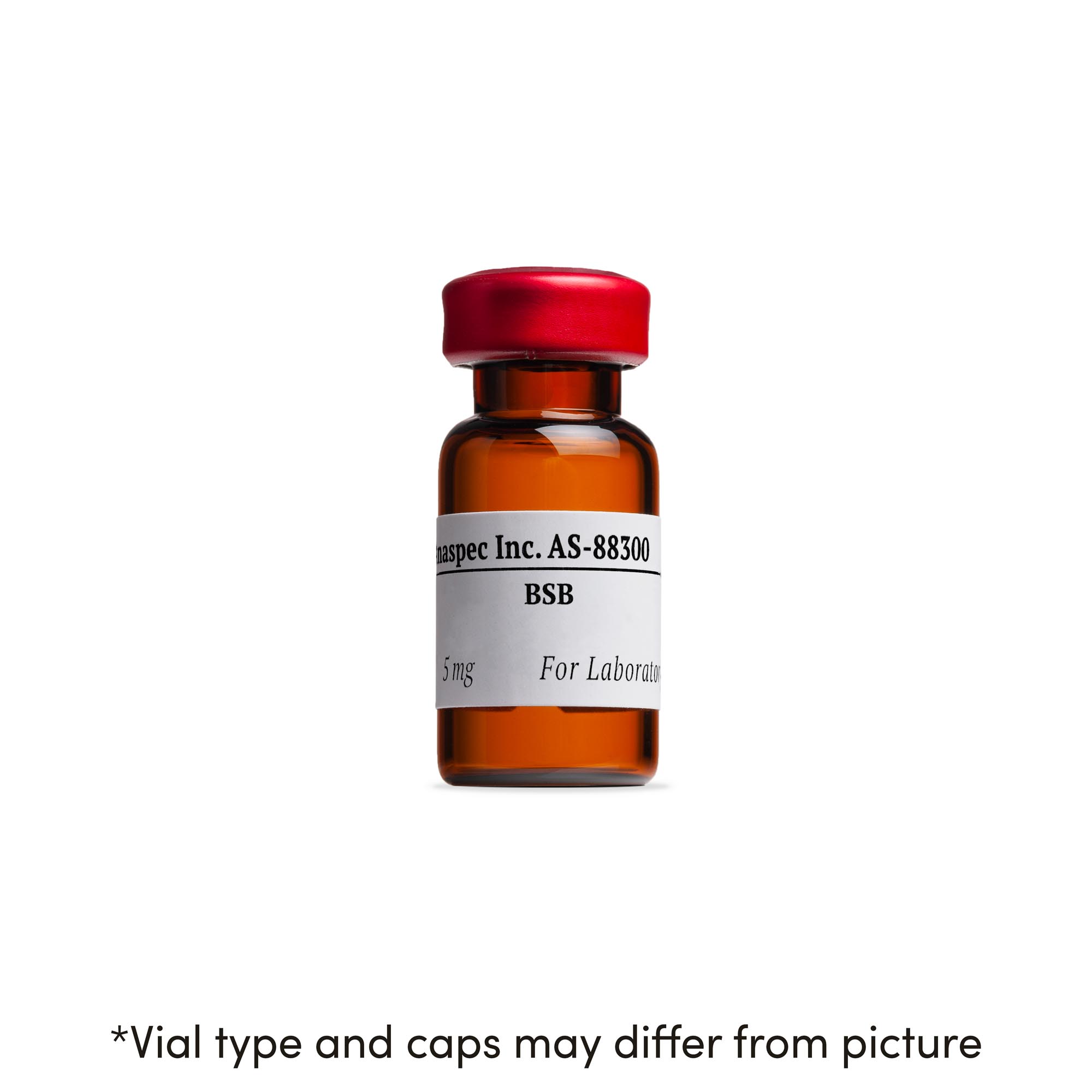
BSB [(trans,trans)-1-Bromo-2.5-bis-(3-hydroxycarbonyl-4-hydroxy)styrylbenzene] – 5 mg
$203.00
BSB cell-permeable fluorescent probe, binds to amyloid inclusions in situ, label brain amyloids in live animals.
Overview
BSB [(trans,trans)-1-Bromo-2.5-bis-(3-hydroxycarbonyl-4-hydroxy)styrylbenzene] is a highly effective fluorescent probe designed specifically for the detection and labeling of amyloid inclusions in live organisms. This compound is essential for researchers studying neurodegenerative diseases, as it provides a unique opportunity to visualize the pathology associated with amyloid formation.
Key Features
- Cell-permeable fluorescent probe
- Specifically binds to amyloid inclusions
- Enables in vivo labeling of brain amyloids
- Quantitative monitoring of amyloid fibril formation
- Recognizes amyloid lesions from Ab peptide, a-synuclein, and tau
Specifications
| Product Code | BSB |
| Weight | 5 mg |
| Fluorescent Range | Green (500 – 550 nm) |
FAQ
How does BSB work as a fluorescent probe?
BSB works by selectively binding to amyloid aggregates within biological tissues, allowing researchers to visualize and monitor these structures in live animals.
Can I use BSB for in vitro studies?
Yes, BSB can be used for in vitro applications, demonstrating a high binding affinity for intracellular b-amyloid aggregates.
What are the implications of using BSB in research?
Using BSB in research can significantly contribute to understanding the mechanisms of amyloid-related diseases, potentially leading to advancements in therapeutic strategies.
Don’t miss the chance to enhance your research on amyloid structures. Purchase BSB today and leverage its unique properties to gain deeper insights into neurodegenerative diseases. Explore more about our DiBAC4(3) fluorescent probes or consider our Calcein, AM products for comprehensive labeling solutions.
Related Products
Browse more in Green (500 -550 nm).
Be the first to review “BSB [(trans,trans)-1-Bromo-2.5-bis-(3-hydroxycarbonyl-4-hydroxy)styrylbenzene] – 5 mg”
Related products
Yellow (550-565 nm)
DiSBAC2(3) [Bis-(1,3-diethylthiobarbituric acid)trimethine oxonol] – 25 mg
Green (500 -550 nm)
DiBAC4(3) [Bis-(1,3-dibutylbarbituric acid)trimethine oxonol] UltraPure Grade – 25 mg
Green (500 -550 nm)
5(6)-CFDA, SE [5(6)-Carboxyfluorescein diacetate, SE] Fluorescent pH Indicator – 25 mg
Reviews
There are no reviews yet.