
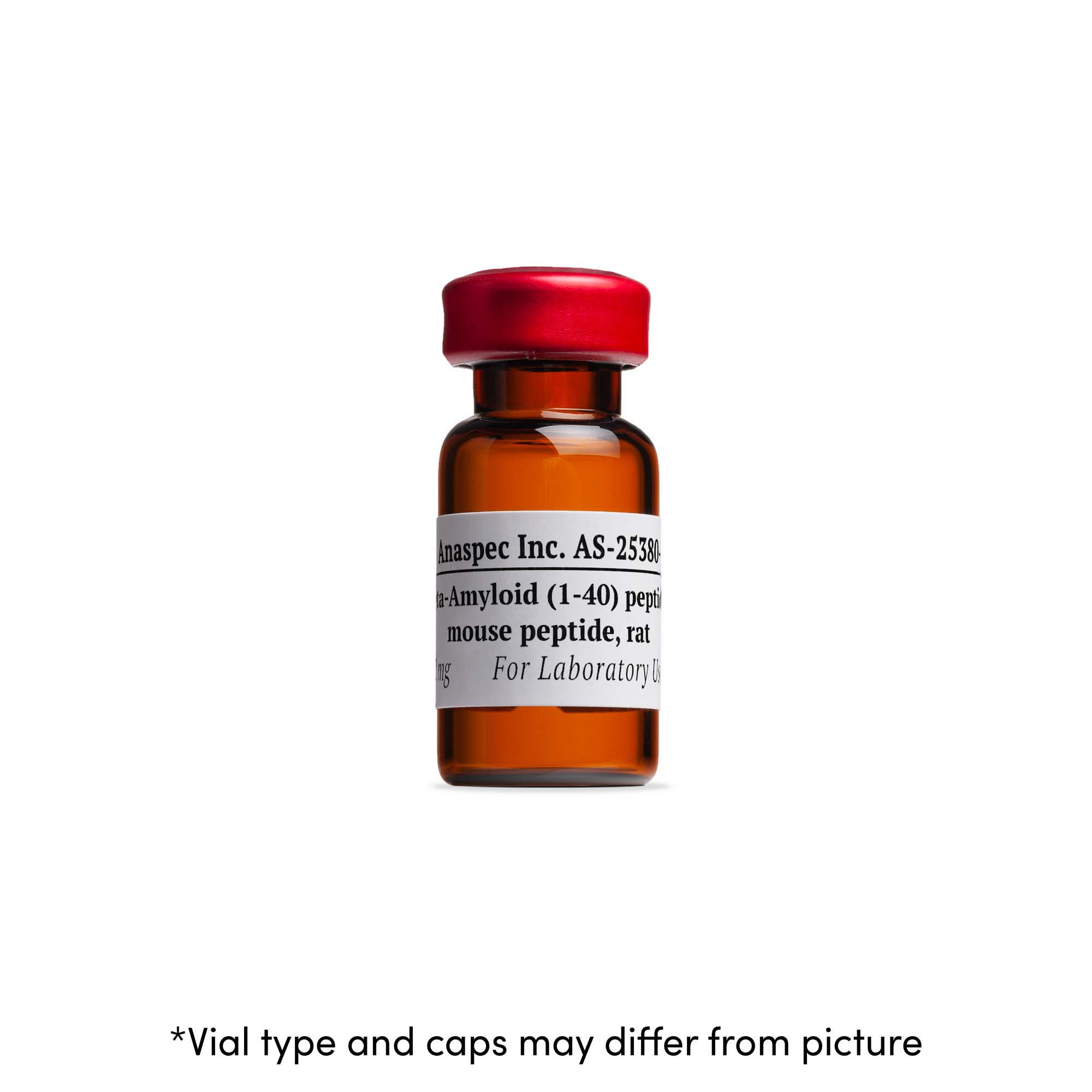
Beta-Amyloid Peptide (1-40), mouse, rat
Price range: $364.00 through $576.00
Beta-Amyloid Peptide (1-40), mouse, rat differs from human Aß: Arg5, Tyr10, His13 in human Aß correspond to Gly5, Phe10, and Arg13 in mice and rat.
Overview
The Beta-Amyloid Peptide (1-40), derived from mouse and rat, plays a crucial role in Alzheimer’s research. This peptide differs from its human counterpart in three specific amino acid positions: Arg5, Tyr10, and His13 in human beta-amyloid correspond to Gly5, Phe10, and Arg13 in the mouse and rat sequences. Understanding these variations is vital for accurate modeling in neuroscientific studies.
Key Features
- Sequence: This peptide includes amino acids 1 to 40 of the beta-amyloid protein.
- Species-specific: Designed specifically for mouse and rat studies.
- Research relevance: Ideal for studies related to Alzheimer’s disease and neurodegeneration.
- High purity: Ensures reliable results in your experimentation.
- Available in convenient sizes: Choose the quantity that fits your research needs.
Specifications
| Property | Details |
|---|---|
| Peptide Length | 40 amino acids |
| Source Species | Mouse, Rat |
| Purity Level | ≥ 95% |
| Form | Lyophilized powder |
FAQ
What is the significance of the amino acid variations?
The amino acid differences in the Beta-Amyloid Peptide (1-40) between species can affect the aggregate formation, which is crucial when modeling Alzheimer’s pathology. By using the correct peptide sequence for your species, you ensure the accuracy of your experiments.
How should I store the Beta-Amyloid Peptide?
For optimal stability, store the peptide at -20°C to -80°C. It is recommended to avoid repeated freeze-thaw cycles to maintain its integrity.
Can I use this peptide for in vivo studies?
Yes, the Beta-Amyloid Peptide (1-40) is suitable for a variety of in vivo and in vitro studies as it is designed for applications in neurological research. Ensure your protocols align with ethical guidelines for animal research.
Order your Beta-Amyloid Peptide (1-40), mouse, rat today and enhance your research into neurodegenerative diseases. Explore our full range of peptides and find the perfect solutions for your scientific needs.
Related Products
| Size | 0.5 mg, 1 mg |
|---|
Be the first to review “Beta-Amyloid Peptide (1-40), mouse, rat”
Related products
Peptides
Peptides
Peptides
Reviews
There are no reviews yet.