
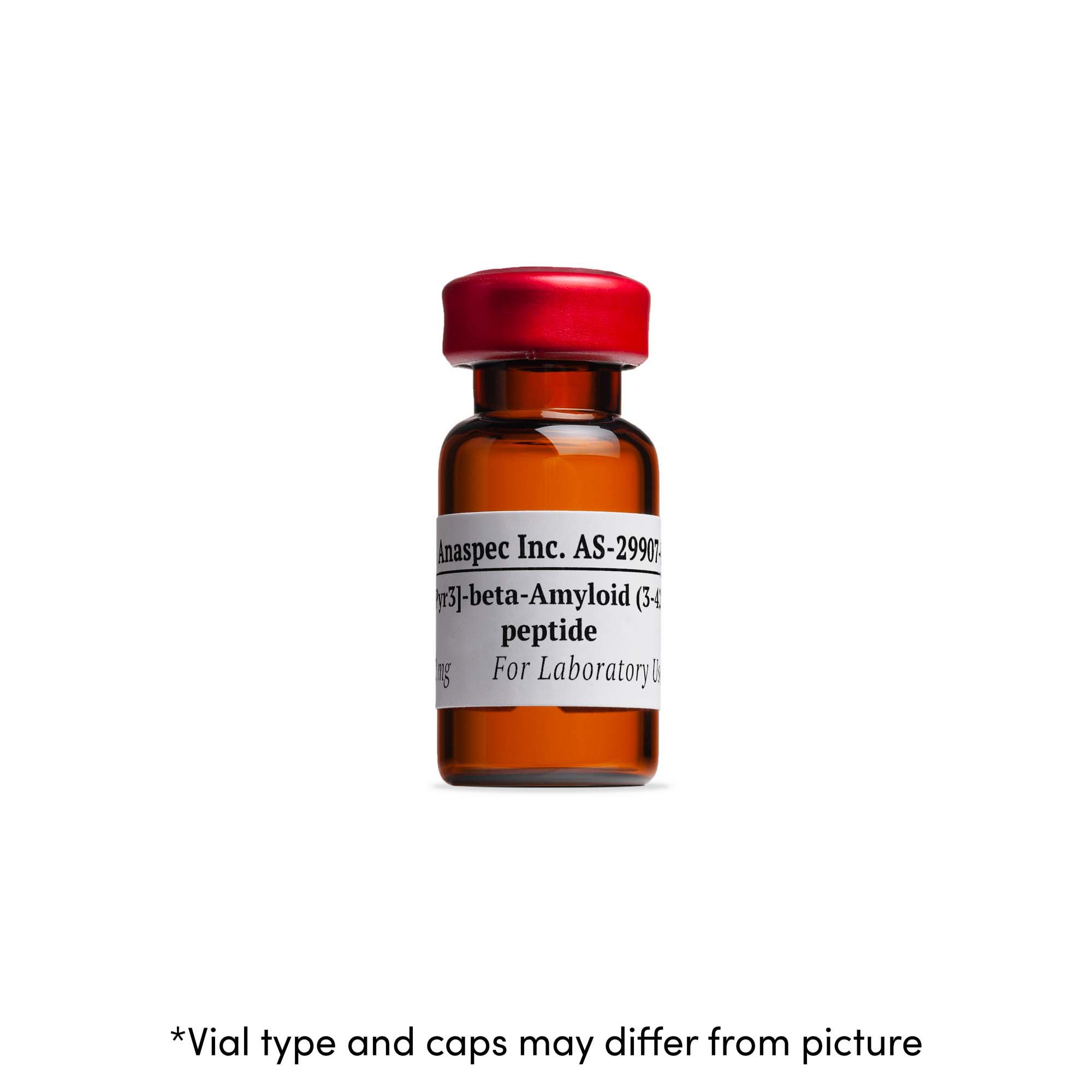
[Pyr3]-beta-Amyloid (3-42)
Price range: $145.00 through $432.00
[Pyr3]-beta-Amyloid (3-42) is one of predominant amyloid peptide structures deposited in human brain of Alzheimer’s disease and Down’s syndrome patients.
Overview
[Pyr3]-beta-Amyloid (3-42) is a significant peptide linked to Alzheimer’s disease and Down’s syndrome, found primarily in the brains of affected individuals. Understanding the behavior of this peptide can be crucial for researchers studying neurodegenerative diseases. As an N-terminally truncated and pyroglutamate-modified variant of beta-Amyloid, it holds importance due to its potent presence in senile plaques. Unlike non-modified beta-Amyloid, these pyro-Glu forms are notably more resistant to degradation, exhibit increased toxicity, and possess a higher propensity for aggregation. This makes them particularly relevant in the context of neurobiology and disease pathology.Key Features
- Critical for Alzheimer’s research and neurodegenerative studies
- Modified form increases aggregation and toxicity
- Useful for testing and development of therapeutic interventions
- Comes in a high-purity, research-grade form
Specifications
| Product Name | [Pyr3]-beta-Amyloid (3-42) |
| Purity | ≥ 95% |
| Quantity | 1 mg |
| Storage | -20°C for optimal stability |
FAQ
What is the main application of [Pyr3]-beta-Amyloid (3-42)?
This peptide is primarily used in Alzheimer’s disease research. It helps in studying amyloid plaque formation and the related neurodegenerative processes.
How should I store this peptide?
For optimal stability, [Pyr3]-beta-Amyloid (3-42) should be stored at -20°C. This temperature protects the peptide from degradation over time.
Is this product suitable for in vivo studies?
While [Pyr3]-beta-Amyloid (3-42) is extensively used in vitro, its suitability for in vivo studies depends on the experimental design and requirements.
For more applications, consider exploring our PKG Substrate and Autocamtide-2.
Related Products
Browse more in Peptides.
| Size | 0.1 mg, 1 mg |
|---|
Be the first to review “[Pyr3]-beta-Amyloid (3-42)”
Related products
Peptides
Peptides
Peptides
Peptides
Reviews
There are no reviews yet.