
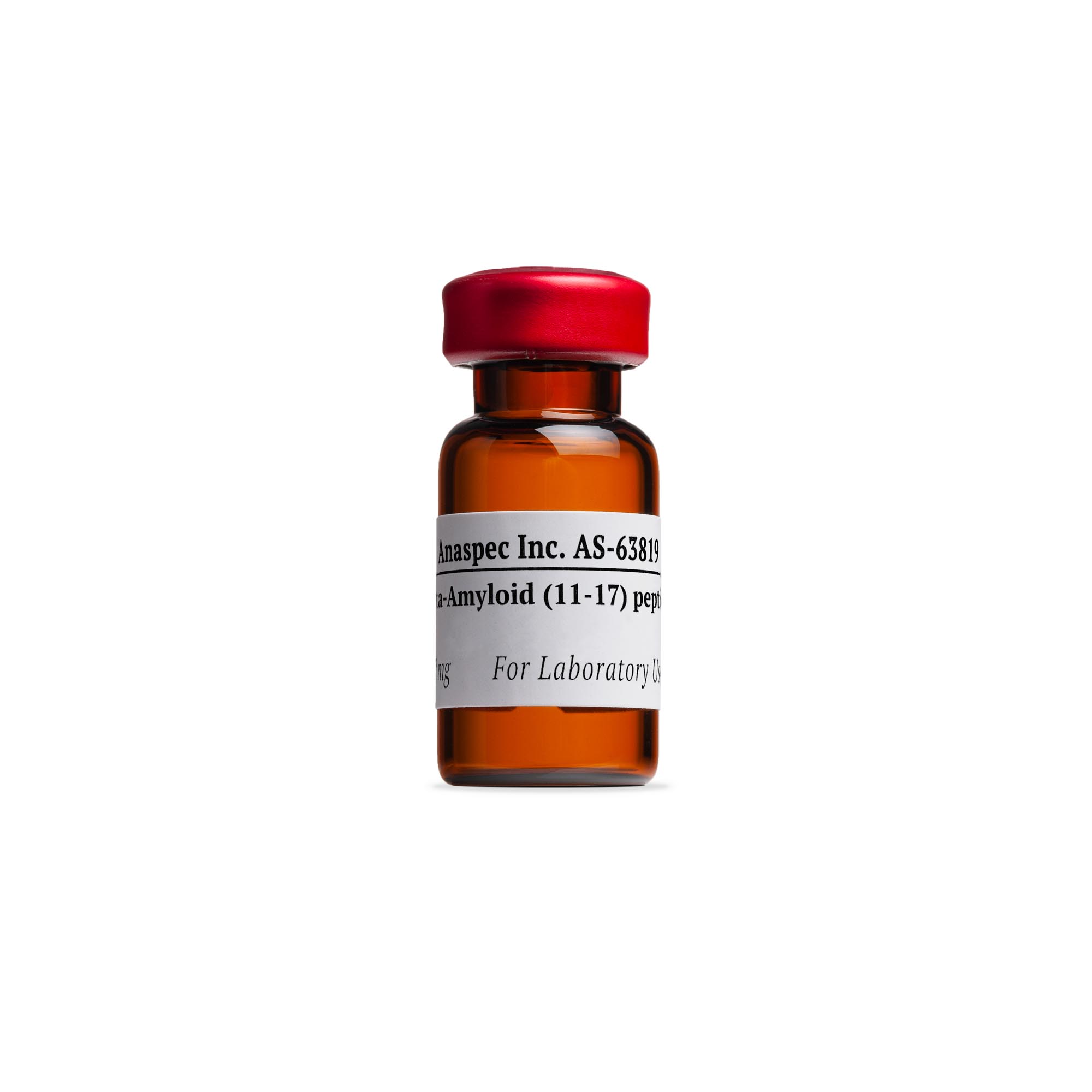
Beta-Amyloid (11-17) – 1 mg
$105.00
Beta-Amyloid (11-17) Histidines 13 and 14 have been shown to be essential for the peptide to inhibit Alzheimer’s disease Ab ion channel and cytotoxicity.
Overview
Introducing our Beta-Amyloid (11-17) peptide, a critical tool for Alzheimer’s research. This specific fragment of the beta-amyloid peptide contains the essential Histidine residues 13 and 14, which play a pivotal role in the peptide’s ability to inhibit the cytotoxic effects associated with Alzheimer’s disease. Research indicates that these amino acids are vital for preventing beta-amyloid’s ion channel activity in lipid bilayers, a process linked to neurotoxicity. By understanding and utilizing this peptide, you can advance your studies in Alzheimer’s pathophysiology and related neurological conditions.
Key Features
- Contains Histidine 13 and 14, crucial for inhibition of Alzheimer’s β-amyloid ion channels
- Supports research in neurodegeneration and cytotoxicity
- High purity and reliability, ideal for experimental applications
- Convenient 1 mg quantity for research purposes
- Compliant with research standards for quality assurance
Specifications
| Property | Details |
|---|---|
| Peptide Sequence | Beta-Amyloid (11-17) |
| Purity | ≥ 95% |
| Quantity | 1 mg |
| Category | Peptides |
| Storage | -20°C |
FAQ
What is Beta-Amyloid (11-17) used for?
This peptide is primarily used in research related to Alzheimer’s disease, particularly in studies exploring its role in neurotoxicity and ion channel formation.
How should I store Beta-Amyloid (11-17)?
To maintain its integrity, store the peptide at -20°C and avoid repeated freeze-thaw cycles.
Can I use Beta-Amyloid (11-17) in live cell assays?
While it is commonly used in vitro, for specific applications in live cell assays, further validation may be necessary based on your experimental design.
Expand your research toolkit by considering our related products, such as PKG Substrate and Autocamtide-2. Dive deeper into protein research with our 5-FAM labeled CREBtide. Explore our extensive range of peptides to find additional tools for your studies.
Be the first to review “Beta-Amyloid (11-17) – 1 mg”
Related products
Peptides
Peptides
Reviews
There are no reviews yet.