
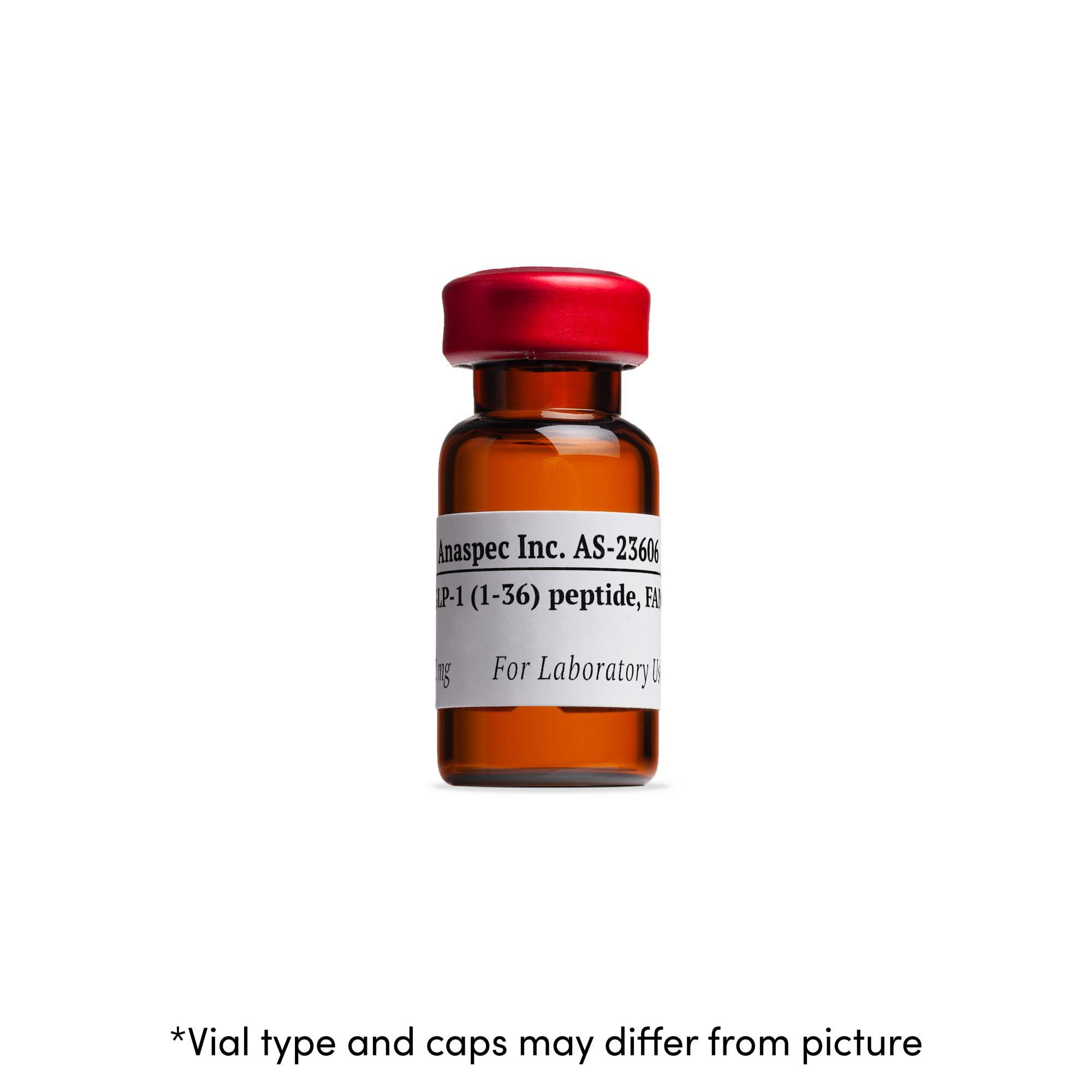
Glucagon-Like Peptide 1, GLP-1 (1-36) amide, human, mouse, rat, bovine, guinea pig, FAM-labeled
Price range: $485.00 through $772.00
In response to Glucose ingestion, proglucagon in the intestinal L cells is cleaved into GLP-1 (1-36). It is further processed into amidated GLP-1 (7-36).
Overview
The Glucagon-Like Peptide 1 (GLP-1) (1-36) amide is crucial for understanding insulin secretion dynamics and gastrointestinal regulation. This FAM-labeled peptide is manufactured for precision in your experiments, allowing you to track GLP-1 activity effectively. Its fluorescence enables real-time monitoring of peptide behavior in biological systems, making it an essential tool for both research and diagnostic applications.
Key Features
- FAM-labeled at the peptide N-terminus for reliable detection.
- High fluorescence with an absorption/emission peak at 494/521 nm.
- Suitable for human, mouse, rat, bovine, and guinea pig studies.
- Facilitates glucose-dependent insulin release studies in pancreatic beta-cells.
- Essential for researching gastric mobility effects.
Specifications
| Item | Value |
|---|---|
| Peptide Sequence | GLP-1 (1-36) amide |
| Labeling | FAM |
| Abs/Em (nm) | 494/521 |
| Species Compatibility | Human, mouse, rat, bovine, guinea pig |
FAQ
What is GLP-1 (1-36) used for?
GLP-1 (1-36) is primarily involved in insulin secretion and plays a role in regulating appetite and gastrointestinal motility. Researchers often use it to study glucose homeostasis.
How do I use the FAM-labeled peptide effectively?
The FAM label allows you to visualize the peptide’s interaction in biological systems. For best results, incorporate it into your assays following the recommended protocols for peptide labeling.
What are the benefits of using labeled peptides in research?
Labeled peptides, like our FAM-labeled GLP-1, provide the ability to track peptide behavior in real time, enhancing the accuracy and reliability of your experimental results.
If you’re looking to enhance your research capabilities, consider our PKG Substrate or the Autocamtide-2. Both products complement your peptide studies and expand your experimental toolkit.
Related Products
Browse more in Peptides.
| Size | 0.5 mg, 1 mg |
|---|
Be the first to review “Glucagon-Like Peptide 1, GLP-1 (1-36) amide, human, mouse, rat, bovine, guinea pig, FAM-labeled”
Related products
Peptides
Peptides
Reviews
There are no reviews yet.