
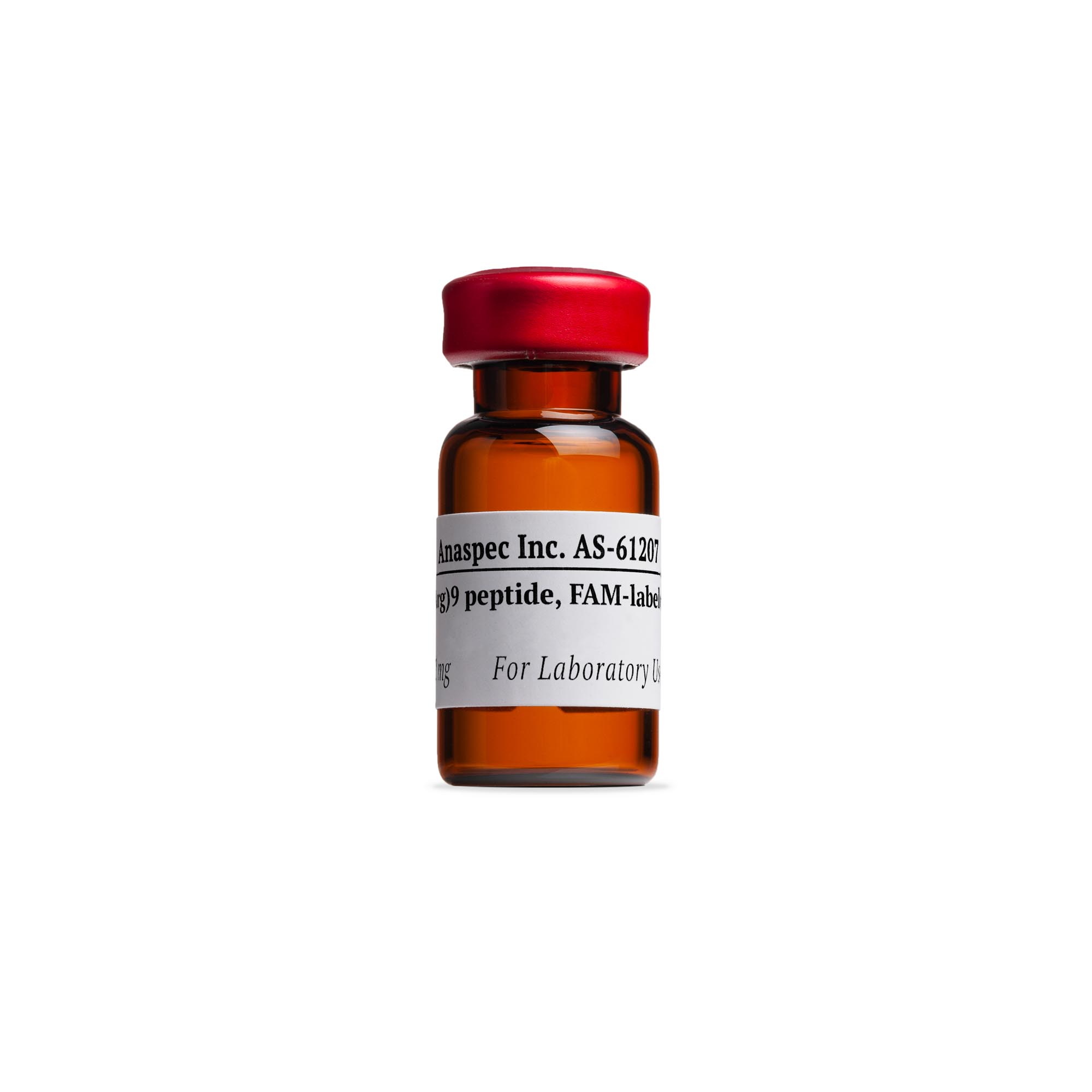
(Arg)9, FAM-labeled – 1 mg
$327.00
(Arg)9, FAM. Cell-permeable peptide used for drug delivery .Poly-Arg peptides composed of 9 arginine residues are able to translocate across cells.
Overview
The (Arg)9, FAM-labeled peptide is an innovative solution designed for drug delivery, ensuring effective cell permeation. Composed of nine arginine residues, this peptide is highly efficient at traversing the plasma membrane of eukaryotic cells, making it an essential tool for your research and development needs. With its fluorescent tag, this peptide has an absorption/emission wavelength of 494/521 nm, which allows you to visualize its location and interaction within biological systems.
Researchers searching for versatile peptides will find that (Arg)9 can significantly enhance drug delivery mechanisms. The ability of poly-Arg peptides to penetrate cellular membranes is critical in fields like pharmacology, molecular biology, and biomedical research. You can explore more about our range of peptides that meet various experimental needs.
Key Features
- Cell-permeable peptide ideal for drug delivery
- Composed of nine arginine residues for effective translocation
- Fluorescently labeled with FAM for easy detection
- Absorption and emission wavelengths of 494/521 nm
- Versatile applications in molecular and cellular biology
Specifications
| Item | (Arg)9, FAM-labeled |
| Category | Peptides |
| Weight | 1 mg |
FAQ
What are the primary applications of (Arg)9, FAM-labeled peptide?
The (Arg)9, FAM-labeled peptide is primarily used in drug delivery studies, facilitating the transport of therapeutic agents across cell membranes.
How does the fluorescent labeling enhance research outcomes?
The FAM label allows researchers to track the peptide’s movement and interaction within cells, offering insights into cellular processes and drug efficacy.
Is (Arg)9 suitable for in vivo studies?
While (Arg)9 has been shown to be cell-permeable, it’s crucial to evaluate its efficacy and safety in specific in vivo contexts depending on your experimental design.
For more options in peptide substrates, you might also consider our PKG substrate or our Autocamtide-2 for complementary studies.
Related Products
Be the first to review “(Arg)9, FAM-labeled – 1 mg”
Related products
Peptides
Peptides
Peptides
Reviews
There are no reviews yet.