
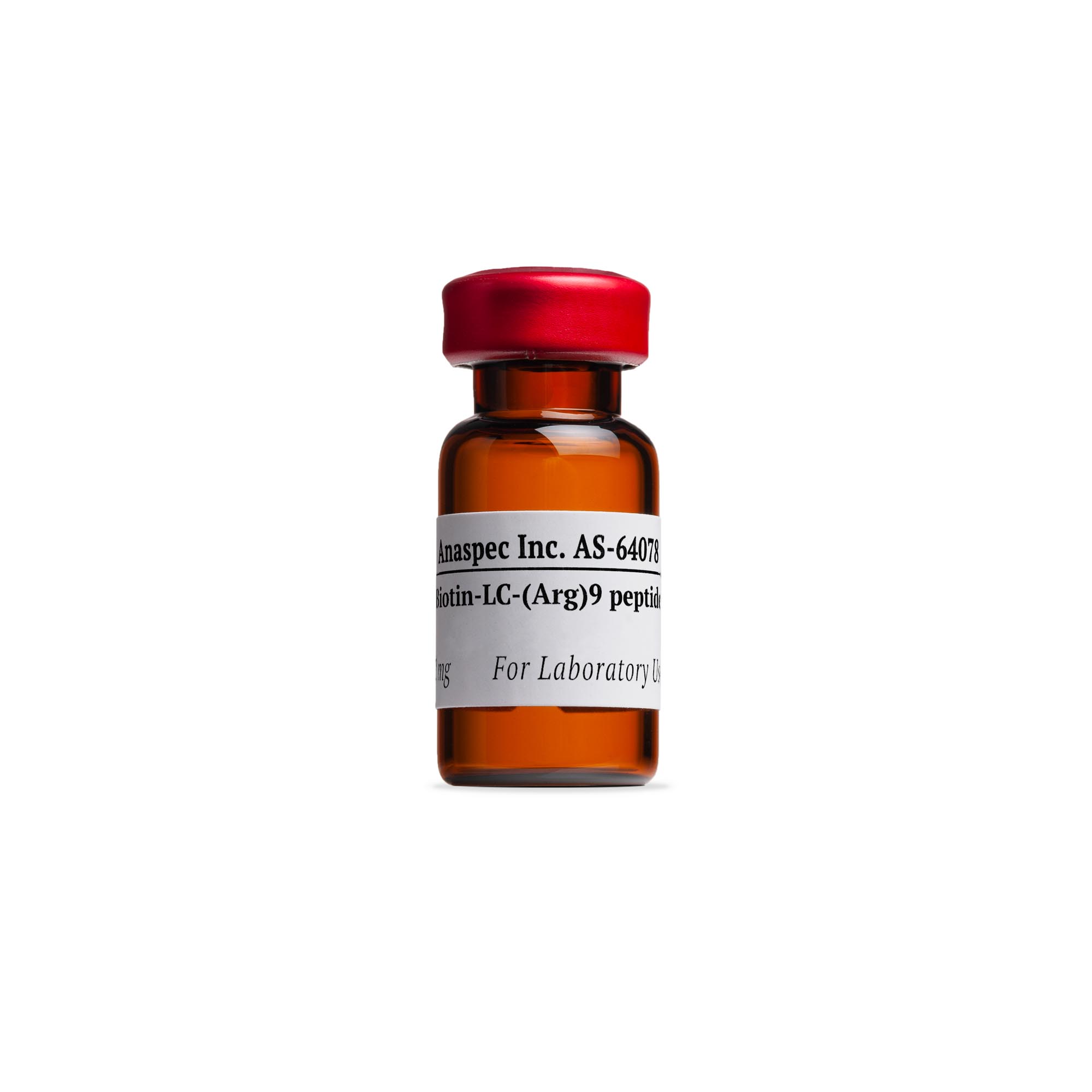
(Arg)9 biotin labeled – 1 mg
$148.00
(Arg)9 biotin labeled, cell-permeable peptide used for drug delivery.It can traverse the plasma membrane of eukaryotic cells.
Overview
The (Arg)9 biotin labeled peptide is a powerful tool for researchers focusing on drug delivery systems. This cell-permeable peptide possesses the unique ability to traverse the plasma membrane of eukaryotic cells, making it an optimal choice for various cellular applications. With nine arginine residues, the peptide is designed to facilitate effective cellular uptake and function. Its biotin group, attached to the epsilon amino group of lysine at the N-terminus, enhances its versatility in experiments involving biotin-streptavidin interactions. By integrating the (Arg)9 biotin labeled peptide into your research, you can optimize your assays and experiments with greater efficiency.
Key Features
- Cell-permeable for efficient drug delivery
- Designed with nine arginine residues
- Biotin label for enhanced detection and affinity
- Facilitates studies involving eukaryotic cells
- Available in 1 mg quantities for flexibility in research
Specifications
| Peptide Sequence | (Arg)9-biotin |
| Quantity | 1 mg |
| Application | Drug delivery, cellular assays |
FAQ
What is the main use of (Arg)9 biotin labeled peptide?
The (Arg)9 biotin labeled peptide is primarily used for enhancing drug delivery systems and cellular assays, allowing researchers to study cellular uptake and interactions effectively.
Can this peptide traverse the plasma membrane?
Yes, the (Arg)9 biotin labeled peptide is designed to be cell-permeable, enabling it to traverse the plasma membrane of eukaryotic cells.
How does the biotin label improve its functionality?
The biotin label allows for specific binding to streptavidin, which is useful for detection and purification processes in various bioscience applications.
You can explore our complete range of peptides to find more solutions tailored to your needs. Additionally, check out our PKG Substrate and Autocamtide-2 for advanced research requirements. Invest in quality products to accelerate your discoveries and enhance your research applications.
Related Products
Be the first to review “(Arg)9 biotin labeled – 1 mg”
Related products
Peptides
Peptides
Reviews
There are no reviews yet.