

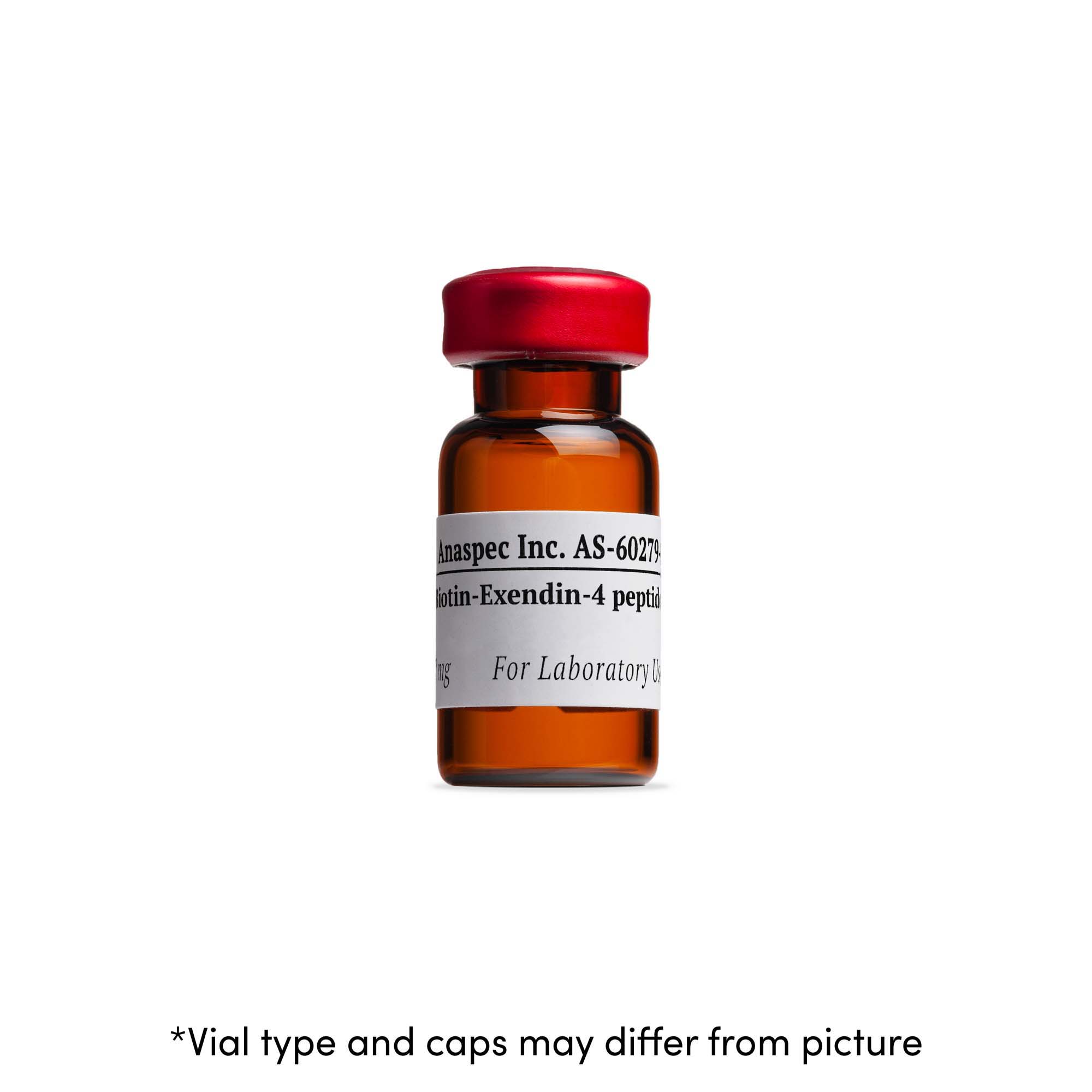
Biotin-Exendin 4
Price range: $522.00 through $851.00
Exendin 4 an agonist of glucagon-like peptide 1 (GLP-1) receptor, induces release of insulin after food intake. This peptide has biotin on the N-terminus.
Overview
Biotin-Exendin 4 offers a powerful approach to understanding insulin release in response to food intake. This synthetic peptide is a potent agonist of the glucagon-like peptide 1 (GLP-1) receptor, stimulating insulin secretion for effective glucose management. Biotin-Exendin 4 is especially notable for its biotin modification at the N-terminus, enhancing its versatility in research and diagnostic applications.
Key Features
- Agonist of the GLP-1 receptor, promoting insulin secretion
- Biotin modification for easy detection and labeling
- Longer half-life than GLP-1, increasing potency
- Derived from the Gila monster, Heloderma suspectum
- 53% sequence homology with GLP-1
Specifications
| Property | Details |
|---|---|
| Peptide Name | Biotin-Exendin 4 |
| Origin | Gila monster (Heloderma suspectum) |
| Modification | Biotin at N-terminus |
FAQ
What role does Exendin 4 play in insulin release?
Exendin 4 acts as an agonist for the GLP-1 receptor, which is crucial for stimulating insulin secretion after meals, contributing to better glucose control.
How does the biotin modification benefit research?
The biotin modification at the N-terminus allows for convenient labeling and detection in various assays, facilitating the study of GLP-1 related pathways.
What makes Biotin-Exendin 4 different from GLP-1?
Biotin-Exendin 4 has a longer half-life in plasma compared to GLP-1, which enhances its effectiveness as an insulinotropic agent, making it a valuable tool in metabolic research.
For those interested in peptide research, exploring our range of peptides can provide additional resources for your projects. With products like Autocamtide-2you can deepen your investigations into peptide dynamics. Plus, don’t miss out on our innovative PKG Substrate for advanced assays.
Related Products
| Size | 0.5 mg, 1 mg |
|---|
Be the first to review “Biotin-Exendin 4”
Related products
Peptides

Reviews
There are no reviews yet.